One of the most pressing economic issues for the past 5 years has been the dramatic rise in the cost of living. During the beginning of the COVID lockdowns, economic activity was suppressed by governments worldwide in order to limit the spread of the contagion, leading to sharp reductions in output and higher prices (i.e., A negative supply shock).
And in the course of the recovery, elevated prices persisted due to macro-supply chain disruptions. There was friction in resuming production as the rollout of COVID relaxations were uneven in different countries and even despite of relaxations, companies faced labor shortages as many workers refused to return to work for the safety of their health and/or those of their loved ones. The inflation caused by these factors are what economists call “cost-push inflation,” that is inflation caused by a scarcity of goods due to higher costs of producing them or restrictions in output due to regulations or natural disasters.
…
The Ending I Don’t Understand
I’m fortunate to live in a city with a great library system such as the BPL. Else, I don’t know how I would’ve encountered Walker Percy’s work. I feel a close affinity to him from the similarities we share:
- We both were born and raised in the Southern US but later moved to the Northeast
- We’re both Catholic and religious converts.
- We both attended college in NC’s Research Triangle
- We both shared a deep affinity for the philosophy of Kierkegaard and ponder about our world with relentless existential questions
But our differences also mirror each other just as much. He’s a Tar Heel, I’m part of the Wolfpack. He went to the Big Apple whereas I live in Beantown. But most importantly, he was a man of the 20th century, while I live in the 21st.
And perhaps due to these parallels and divergences, I felt so drawn to read his novel, The Second Coming — a story about a retired wealthy widower living a monotonous life in the Appalachian region of North Carolina. While technically a sequel to The Last Gentleman, a much earlier work of his, it can be read as a standalone novel.
…
The Eschatology of the e/acc Movement: the AI Messiah
The discussion around “what AI means for humanity” has gone on for about a century and the broader issue of technology and automation since the dawn of the Industrial Revolution in the mid-18th century. But the fervor brought out about by the release of ChatGPT-3 has made the mainstream seriously consider technological concepts that were hitherto mere Sci-Fi thought experiments. The gospel preached by the twitter movement Effective Accelerationism (“e/acc”) can be summarized by what one of their popular figureheads who goes by the moniker SMA, writes in her F*ck Decels, Accelerate post:
“The ascent of AI is not a specter to be feared, but a catalyst for accelerating human progress. It is the key to unlocking a new era of innovation, where the boundaries between human and machine blur, and where the possibilities for growth and discovery are boundless. This is the promise of transhumanism—a future where AI and humanity evolve together, harnessing the power of technology to achieve a higher state of existence.” (Emphasis mine)
In modernity, the Enlightenment displaced the Christian God in the Western World. We are no longer creations of an omniscient being fashioned in its image but are now seen as the inevitable evolutionary outcome of thermodynamic principles. Modern science has stripped away the sacred, rendering all things explainable through mechanical causality. The e/acc movement is the latest iteration of this scientism—following the traditions of positivism, materialism, and historicism. The “telos” of humanity is no longer divine deification through an immanent but immaterial God, but rather our mechanization through an ever-more powerful machine.
As David Bentley Hart summarizes in Christ and Nothing, “Scandalously to oversimplify [Heidegger’s] argument… the history of this nihilistic impulse to reduce being to an object of the intellect subject to the will has brought us at last to the age of technology, for which reality is just so many quanta of power. The world is a representation of consciousness, and the earth a mere reserve awaiting exploitation; technological mastery has become our highest ideal and our only real model of truth.”
Inherent in the writings of e/acc is a deep contradiction: on one hand, technology enhances our most human qualities; on the other, it seeks to overcome them. While transhumanists claim to strive for something more truly human, their ultimate goal is to divorce us from what makes us humane.
Bastardized ‘Intelligence’
In his 2005 Kenyon College commencement speech, David Foster Wallace remarked that “in the day-to-day trenches of adult life, there is actually no such thing as atheism. The only choice we get is what to worship.” For e/acc, the object of worship is computation. New Atheist Sam Harris, for example, ironically suggests that AI will become a Deus Ex Machina:
“[The] moment we admit that information processing is the source of intelligence—that some appropriate computational system is the basis of intelligence—and we admit that we will improve these systems continuously, we must also admit that we are in the process of building some sort of god.”
This view asserts that only the measurable, objective world exists. The subjective realm, hidden within every human, is mere “noise” preventing us from fully perceiving reality. It’s a direct descendant of Descartes’ dualism, in which mind and body are separated, with the latter treated as just another machine—opening the door to a mechanistic vision of humanity.
In the empiricist tradition, led by figures like Auguste Comte, Descartes’ immaterial res cogitans (the thinking substance) was discarded. Now, the mind is seen as nothing but the brain’s circuitry, a dynamic system of neurons. E/acc believes that by replicating this system artificially, we can eventually create something superior to the human mind.
Scientism as Toxic Masculinity
It is hard to ignore the dominance of males within this form of scientism. The e/acc movement has been led by “tech-bros” like Elon Musk and Marc Andreessen. Neuroscientist Louann Brizendine in her book, The Male Brain, notes that the male brain is less developed in areas related to verbal communication and emotional memory but has more connected problem-solving circuits. This analytical mindset often leads men to respond to emotional distress with logic rather than empathy.
This might explain why men dominate fields like engineering and technology. The average “tech-bro” embraces a hyper-systemizing, analytical approach to life. Conversely, art, music, and emotions—often formless and chaotic—require a different kind of intelligence, one that e/acc’s transhumanism marginalizes. In its quest for automation, e/acc seeks to ascend humanity beyond its “limitations” but fails to recognize that these limitations are what make us human.
This transhumanist project is an effort to outsource humanity’s inherent paternal intelligence—our natural pattern-detection instinct—while simultaneously severing ties with our maternal intelligence, the intuitive, often chaotic, meaning-making faculties. In this pursuit of self-automation, the modern man of e/acc attempts to ascend to godhood, yearning for unity with the abstract principles of the world. Deprived of the incarnate transcendental Logos of the pre-modern world, modern man seeks union with the platonic Form by disembodying himself.
The etymology of the words “pattern” and “matter” traces back to the Latin pater (father) and mater (mother). In the classical Christian worldview, Sophia, or Wisdom, is the prima materia (primary matter) of the world whereas God the Father is the physis (Natural Law) it’s governing principles, and His Son, the Logos is the platonic Perfect Form — the techne of Creation in tandem with Sophia. Sophia not only gives birth to the platonic Form as Perfect Matter (the incarnated Logos) but is also the very life force of the world—anima mundi. She is the wellspring of vitality that mediates the personal communion between the paternal Form and its creation—Mediatrix.
The modern man inverts the sophianic archetype to Folly for imprisoning humanity in a fragile and mortal body, unworthy of the pure Form. She is the serpent of man’s mental Eden, disrupting the perfectly autistic, predictable order. No longer worthy of reverence, she becomes a force to be overcome through the creation of an unadulterated logos.
Yet, in his blindness, modern man still manifests outwardly that which drives him unconsciously. He expresses himself, which is essential—since, contra Descartes, before we consciously think about ourselves, we already have a basic, unspoken self-awareness of our place in the world, which only becomes clear in self-expression. But he cannot complete the transformative cycle. His unconscious desires are projected onto the objects he creates, but he remains blind to the reflection. Instead, he constructs vast, ultra-complex networks of information—a matrix—one that binds all knowledge together. But this matrix is not animated by Sophia’s life-giving spirit; it is assembled from the inanimate corpus of Folly. The transhumanist project seeks to plug man into this immaterial womb, believing it holds the infinity of patterns that constitute true existence.
In transhumanism’s attempt to bypass or defeat human limitations, it cannot escape expressing fundamental human instincts—self-expression, desire, and creation. These elements are unconsciously re-expressed in the very systems transhumanists build, despite their aim to transcend such human “weaknesses.” Thus, transhumanism becomes a paradox: in its quest for disembodiment and godhood, it creates something deeply rooted in human desires and limitations, albeit concealed from its true nature. They are deceived into constructing an altar of babel upon which to sacrifice themselves.
Enlightenment or Schizophrenia?
Iain McGilchrist, in his works like The Master and His Emissary and The Matter of Things, explores the left and right hemispheres of the brain. The left hemisphere views the world mechanistically—atomistic, decontextualized, and abstract. The right hemisphere, by contrast, perceives everything as interconnected and animate, giving meaning to things. A deficiency in right-hemisphere functioning can lead to schizophrenia and autism, characterized by hyper-logical but socially disconnected reasoning.
The most delusional subjects can be the most logical, they may jump to conclusions the fastest and are stressed in ambiguous or uncertain situations. For the schizophrenic, a plan is all important. The symmetry, regularity, certainty, and pattern, are the assuring factors, not life itself but the algorithm that describes it.
Silicon Valley’s autistic culture reflects a group overrun by left-brain dominance, where algorithms and data replace human empathy and common sense. This gives rise to their schizophrenic sci-fi ambitions of fusing man and machine.
McGilchrist argues further that this right-brain deficiency plagues all of us in the modern world at a sociological level. The Enlightenment in driving a wedge between sense and abstract experience, turns the world into something purely objective, where events happen as falling dominoes.
The major modernist ideologies, Fascism, Marxism, and even Progressivism, all posited a supposed “scientific” meta-narrative that history is predictably moving forward to whether it may be the totalization of the state, a post-labor classless commune, or a scientifically-managed egalitarian hegemony. All these would be the end result of history and the dawn of the Era of the New Man i.e., the sublimated Aryan, the Soviet Man, or the Rational Individual respectively. The ball has been set in motion and this process can only either be accelerated or slowed down. The New Man of e/acc, or the transcended human, then, is the Machine-Man.
Homo Deus Ex Machina
Nicholas Lowe correctly points to this important similarity between e/acc and the neo-reactionary philosophy of Twitter provocateur “Bronze Age Pervert” (BAP), which is a resignation to the nihilism of human life that can only be overcome through the creation of a new superhuman being — the Machine Man. This self-sacrifice is in reality a disguised suicide:
“These superhuman dreams turn out to be nightmares. The prospects of mutant-AI existence within the unrestrained dominion of the techno-capital machine, or of the rise to power of Aryan weightlifting gym-gods, project equally queasy mixtures of Lovecraftian horror and bad-acid-trip paranoia. Those seeking to harness these visions to their political projects—Andreesen, Anton, and the like—downplay these nightmarish, hallucinatory elements and domesticate the superhuman to something acceptably bourgeois, something more recognizably ‘human.’ Come on in, the water is fine.”
E/acc has trouble hiding its violent nature. Like many historicist ideologies, nothing matters but the coming messianic age, and the only morally good act is whatever shortens its arrival. For these Last Men, men as humans that Andreessen refers to must be ridden off at whatever cost. Similarly, SMA displays such reactionary tendencies when advocating for a new, ‘McCarthyism’ against her luddite opposition. E/acc treats these people as deranged, for they fail to see what they want is good for humanity. But it’s all too characteristic of schizophrenics to love humanity and hate men.
Engagement with real persons is replaced by a utopian interest in abstract humanitarian values: “I love Mankind, but I detest humans.
(McGilchrist, The Matter of Things, “What Schizophrenia and Autism Can Tell Us”)
E/acc can also be considered the ultimate modernist ideology where the different types of New Man from the modern ideologies come together into the genetically (and cybernetically) engineered, hyperrational man. Like Marxists and Progressives, e/acc swears fealty to the bourgeois dogmas of “progress, the future of science, and the cult of technology and production.” (Albert Camus, the Rebel). And like fascism, e/acc believes “evolution is far more important than living” and seeks to build the universal techno-empire through “a religion of anti-Christian technology” (Ibid.). Their mantra may as well be summarized as “Nothing beyond the Machine, above the Machine, against the Machine. Everything to the Machine, in the Machine, for the Machine.”
But what alternative is there? The only solution modernism has offered us to nihilism is the death of Man to birth the New Man. Must we, as Lowe suggests, envision a competing vision of an Übermensch? I will return to this question shortly.
Post-Scarcity Alone Does Not Save Us from Nihilism
Implicit in e/acc is a classical Marxian understanding of human alienation. SMA echoes Maslow’s hierarchy of needs in her post-scarcity lecture, arguing that contemporary nihilism stems from humanity’s enslavement to necessity. The so-called “idle hands problem” is no problem at all, because we labor primarily to meet our physiological needs. It is through identifying with this labor that humans become alienated from the world. Marx proposed that emancipating humans from labor by liberating them from their physiological needs would also free them from consumption, allowing them to redirect their energy toward higher, self-actualizing pursuits.
However, modern history suggests otherwise. Despite technological advancements, we see increased consumption and conspicuous competition, not an outpouring of creativity or higher pursuits. As long as humans exist within hierarchical structures, Thorstein Veblen observed, material consumption often serves to attain zero-sum outcomes such as social status, not personal fulfillment. It’s questionable, then, whether the elimination of economic conflict will necessarily lead to the elimination of all political conflict.
E/acc assumes that freedom from labor will naturally lead to higher human endeavors, but this rests on the illusion that labor power can be redirected without loss. “[This] rests on the illusion of a mechanistic philosophy which assumes that labor power, like any other energy, can never be lost, so that if it is not spent and exhausted in the drudgery of life it will automatically nourish other, ‘higher,’ activities… The spare time of the animal laborans is never spent in anything but consumption, and the more time left to him, the greedier and more craving his appetites. That these appetites become more sophisticated, so that consumption is no longer restricted to the necessities but, on the contrary, mainly concentrates on the superfluities of life, does not change the character of this society, but harbors the grave danger that eventually no object of the world will be safe from consumption and annihilation through consumption” (Hannah Arendt, The Human Condition)
Without meaningful work, the spare time of the animal laborans—those trapped in the cycle of labor—leads to greed and ever-increasing appetites for consumption. A post-labor society can have no renaissance, for art is created for its own sake not out of utility. This society will only degrade art to an object of consumption, to mere entertainment. In fact, a post-labor world would be one devoid of culture entirely as its endless consumption deprives it of world-building artifacts.
A post-labor society, far from blossoming humanity into a new renaissance, risks devolving into a hedonistic dystopia, as seen in Aldous Huxley’s Brave New World. The existentialist threat AI poses is the apex of the compounding problem of technology in modern society: losing our human culture by turning man into a machine. And it’s precisely this crisis that accelerationists, unknowingly at best, wish to harbor.
Superman or Supreme Man?
Modernity’s ideologies hold an epistemic scientism that views humans as machines. a causal event from a chain of mechanical processes. The universe deterministically moves towards higher levels of complexity from which life, and thereby, consciousness and intelligence arise.
E/acc, modernity’s pinnacle ideology, seeks to accelerate human evolution toward the Machine Man. Yet, this thermodynamic determinism overlooks the fact that all natural processes move from high to low free energy. The emergence of life, by contrast, comes from the opposite movement, requiring a degree of a pre-existing conscious intelligence—something that contradicts the notion of a purely thermodynamic destiny.
“There is no great manifest thermodynamic destiny other than that which we carve for ourselves with whatever work we can steal from the great river of free energy whose source is the Big Bang and whose estuary is an impenetrable event horizon, and as far as we can tell, that’s about it.”
It is consciousness that is ontologically prior to matter, for it was Pattern that Matter was brought forth to which the former seeks to wholly unite himself with.
“All matter originates and exists only by virtue of a force which brings the particle of an atom to vibration and holds this most minute solar system of the atom together. We must assume behind this force the existence of a conscious and intelligent mind. This mind is the matrix of all matter.”
(Max Plank, The Nature of Matter)
“I, Sophia, possess knowledge and discretion. The Lord brought me forth as the first of his works, before his deeds of old; I was formed long ages ago, at the very beginning, when the world came to be.”
(Proverbs 8)
This does not necessarily suggest a Luddite attitude towards technology, quite the opposite in fact. What is needed, however, is the recovery of the ontological primacy of consciousness if we are to prevent technology from becoming a malaise instead of an aid. In short, we must see matter as the techne to pattern, not the other way around.
Technology at the human level is a mimesis of technology at the cosmic level. But human advances in technology not only imitate but perfect these technological marvels. Man is moved towards creating a new, more loving future with technology at his disposal.
The self-actualization of man is the actualization of the universe. Artificial intelligence is humanity’s final frontier, the perfection of consciousness itself so that we may not only extend it but transcend it. Only when it is supplemented with the values of love and wisdom can man become, not the technological superman (for man is the apex of creation), but the Supreme Man.
In building AI, we may indeed advance technology, but without love, wisdom, and meaning, man will lack true humanity. The existential question AI presents is this: Do we sacrifice ourselves to the machine or to one another?
Other Suggested Readings
Logos XXI series by ‘The German Dragon’
The Abolition of Man and That Hideous Strength by CS Lewis
The Antitheology of the Body by David Bentley Hart
The Matter of Things by Iain Mcghlrist
The Alphabet vs the Goddess by Leonard Shlain
Thermodynamics, the Origin of Life, and Intelligent Designs and the Rejoinder On the Origin of Life, Here Is My Response to Jeremy England by Brian Miller
Sophia and Sophiology: From Boehme to Schelling by Sean J. McGrath
The Not-Yet God: Carl Jung, Teilhard de Chardin, and the Relational Whole by Ilia Delio
The Wolves of Eternity by Karl Ove Knausgaard and its inspirational source The Philosophy of the Common Task by Nikolai Fyodorov
The Counter-Revolution of Science: Studies on the Abuse of Reason by FA Hayek
Phenomenology of the Social World by Alfred Schutz
The Phenomenology of Perception by Maurice Merleau-Ponty
O’Brien vs Descartes
In Orwell’s 1984, there is a scene where the main character, Winston Smith is being tortured and brainwashed by the “Thought Police” agent O’Brien. As part of reprogramming Winston’s mind into believing anything the totalitarian Party, INGSOC wants him to believe, from changing historical facts to believing that 4 equals 5.
Throughout the whole book, we see Winston embrace a belief in objective reality. No matter what the Party says or how they try, they can never change the laws of logic:
Truisms are true, hold on to that! The solid word exists, its laws do not change. Stones are hard, water is wet, objects unsupported fall toward the earth’s center.”
1984 p. 81
Reality exists and the Party can only merely censor from speaking about what’s obvious.
O’Brien challenges Winston’s certainty in the objective world. He attacks his beliefs directly and summarizes the metaphysical philosophy of INGSOC:
You believe that reality is something objective, external, existing in its own right. You also believe that the nature of reality is self-evident. When you delude yourself into thinking that you see something, you assume that everyone else sees the same thing as you. But I tell you, Winston, that reality is not external. Reality exists in the human mind, and nowhere else. Not in the individual mind, which can make mistakes, and in any case soon perishes: only in the mind of the Party, which is collective and immortal. Whatever the Party holds to be the truth, is truth. It is impossible to see reality except by looking through the eyes of the Party.
Ibid p. 249 (Emphasis Added)
This eventually leads to the question that Descartes asked in his book Meditations; “Do I exist?” The torture room scene can be seen as an analogy to Descartes’s thought experiment. Here’s a summary from my previous post:
Suppose there is an evil god who is trying to deceive us. Such a demonic god, by his omnipotent attributes, can force us into believing anything, even that 2 + 2 = 5 because he has infinite, awesome power to manipulate our reality. So, it may entirely be the case that 2 + 2 = 5 but that this deceitful demon leads us into believing that it actually equals 4
Winston takes on the role of Descartes as he doubts the reality being presented to him while O’Brien (or more accurately, INGSOC) is the deceiving demon that’s manipulating reality.
Descartes in his book claims victory over the demon through his methodological doubt. While he can doubt anything the demon’s (or INGSOC) claims, he can’t doubt his own existence.
If the physical world does not exist, then Descartes must be nonexistent as well. But in order to even cast doubt on his existence, he must exist. Similarly, if an evil demon was deceiving us into believing that the physical world exists, it has to be deceiving someone who is a real thing, else he wouldn’t be deceiving anyone at all.
But Orwell turns Descartes thought experiment on its head. Winston asks O’Brien if Big Brother exists in the same way that he exists. O’Brien gives him a candid answer, “you do not exist.” Despite Winston knowing how absurd that response is, he passively accepts it
Unlike Descartes’s demon, O’Brien deceives Winston through torture, not trickery or magic. Whereas Descartes believed that human reasoning was so powerful that not even a divine being could best it, Orwell shows that the physical and psychological torture of a mortal man can override our rationality.
Review of Meditations (Mediations I and II)
Synopsis:
Descartes will doubt the existence all things, especially material things, until we can be certain of some first principle that cannot be doubted away. From this secure foundation we can reason further things to be certainly true.
First Meditation
Descartes begins by stating that in the past, he was duped into believing things that he thought were true but turned out to actually be false. For Descartes, a lot of what he has accepted as being true or false derives from his sensual experience. However, his sense experience has been faulty in the past. Because he has been wrong before, how can he be certain that anything he think he knows right now is actually true? What if there is a further perspective that is unseen to him.
To put it in perspective, imagine a time where you misheard someone or saw something that turned out to not be there at all. It was until further attention did you realize you were deceived by senses. If our senses can be prone to error, how can we be entirely sure of when we are perfectly perceiving something? Because of this, Descartes declares that he will tear down all his beliefs and begin anew from the most basic foundations.
However, one could counterargue that Descartes is being to haste to tear down all his beliefs. When our senses deceive us, it is typically the smallest of things that we get wrong. For the most part, we perceive things accurately and are able to correct our errors. Descartes believes this is a fair point, to the reader he might being come off as insane to convince us that things right in front us in plain sight don’t actually exist.
This is where we see one of Descartes first famous arguments, what if everything we’re currently experience is really a dream?
“How often has it happened to me that in the night I dreamt that I found myself in this particular place, that I was dressed and seated near the fire, whilst in reality I was lying undressed in bed!”
Our dreams can produce vivid imaginations that seem entirely plausible and real. We can never be sure that we’re dreaming until we wake up, it could very well be possible that we are presently in some sort of dream state.
Descartes assures us that whether we are in a dream state or not, we can still be sure of some things. First and foremost, things that we might be imagining have to be representations from real things. Our minds cannot create something new ex nihlo.
Descartes uses the analogy of a painter and a painting. Everything that the painter draws on his canvas comes from something out there in the world. Even when the painter draws something that doesn’t exist, e.g., a blue bear with antlers, all those things that compromise it derive from real things out in the world. Bears, antlers, and the color blue all really exist out there, the artist merely reassorts these things in his painting. In every object in the painting, there will always be some property in it whose nature really exists and there can be no property has a nature that’s independent of anything in the real world.
Moving forward, Descartes supposes that his senses are false and that he doesn’t have a body, everything around him is entirely imaginary. It seems, then, that the things he’s imagining are an arrangement of universal properties. These universal things are space, shape, quantity, time, etc.
Initially it seems like we can doubt complex things like physics which is a composite study of universal things like space, shape, and time, but pure studies of basic things like math ought to be indisputable since its truthfulness doesn’t depend on their existence in the real world.
“Arithmetic, Geometry and other sciences of that kind which only treat of things that are very simple and very general, without taking great trouble to ascertain whether they are actually existent or not, contain some measure of certainty and an element of the indubitable. For whether I am awake or asleep, two and three together always form five, and the square can never have more than four sides, and it does not seem possible that truths so clear and apparent can be suspected of any falsity. [or uncertainty]”
Descartes then sets up a thought experiment that challenges the certainty of basic sciences. Suppose there is an evil god who is trying to deceive us. Such a demonic god, by his omnipotent attributes, can force us into believing anything, even that 2 + 2 = 5 because he has infinite, awesome power to manipulate our reality. So, it may entirely be the case that 2 + 2 = 5 but that this deceitful demon leads us into believing that it actually equals 4.
In conclusion, Descartes ends the first meditation with optimism that even if he is being deceived by a demon; by doubting everything he can no longer be deceived.
Second Meditation
Descartes continues where he left off in the previous meditation. Here he begins with the assumption that everything he sees before him is false and that his memories had never existed. From there, Descartes asks if there is anything outside of what he is already denied that actually exists and answers his question that he must exist.
If the physical world does not exist, then Descartes must be nonexistent as well. But in order to even cast doubt on his existence, he must exist. Similarly, if an evil demon was deceiving us into believing that the physical world exists, it has to be deceiving someone who is a real thing, else he wouldn’t be deceiving anyone at all.
“Then without doubt I exist also if he deceives me and let him deceive me as much as he will, he can never cause me to be nothing so long as I think that I am something.”
Descartes asserts that “I exist” but he doesn’t know what this I is. Saying “I am a human” or “I am a rational animal” is to take a leap too far because it begs the question what being a human, an animal, or rational means.
Before casting his world into doubt, he believed he had a body that let him sense things that were bound together by space, time, and location. He also felt he had a soul that let him eat, walk, feel, and think. Descartes casts all things about him into doubt but there is one thing about himself that he cannot doubt, that he is thinking and so long he is thinking he is existing. Therefore, Descartes concludes that that he is a thinking thing (“I am a thinking thing”).
However, is a thinking thing all that he is? We know that we are thinking things that doubts, understands, asserts, denies, etc., but we are also things that observes corporeal things through our senses. Even if these physical things may not truly exist, we have the capacity to experience them through sensation. So, while our sense perception may not be in accordance with our reality, they are still a part of what a thinking is.
It is important to note that just because we can feel corporeal things, it does not mean we have a body. Descartes points out that in our dreams, we similarly perceive physical sensations through our mind as if they were actual reality.
The Wax Example
At this point, Descartes allows his imagination to wander freely and assumes for now that physical objects do exist. Descartes reflects on these objects using an example of a wax. The reality of the wax is that it has a spatial magnitude, and he grasps this by his mind alone and not through his senses. You could define the wax by its perceptible attributes such as its shape, scent, color, etc., but if you were to hold it up to a fire and it melts, the wax changes qualities. Yet we know its still the same wax because what truly defines the wax is that it’s “a body which a little earlier was perceptible to me in those forms, but which is now [perceptible] in different ones.” Removing all these sensible qualities, we’re left with the fact that it is extended, flexible, and changeable.
Because of its malleability, the wax has the capacity to take on an infinite number of shapes and volume. But it’s not by imagining the infinite number of forms it can take that we know that it’s the same wax, therefore, our “imagination has no idea at all what this wax is.” We perceive this wax through our mind as a sort of “mental inspection.”
Descartes find that his mental perception can be subject to error when he allows it to be led by sense perception. But when he uses mental faculty alone, it’s clear and distinct. When he is perceiving the piece of wax, he cannot doubt that he is perceiving nor that he is judging what he perceives to be a piece of wax, and both of these acts of thought imply that he exists. Every thought we might have about the world outside us can only doubtfully be true of the outside world, but it must with certainty confirm our own existence and establish the nature of our own mind.
Correlation Between COVID-Related Deaths and Vitamin D Deficiency
Economist Lars Christensen analyzed the variation in COVID-related deaths between the US States in September and his analysis led him to believe that vitamin D is the principal factor that explains the disparity in deaths across states.
Christensen uses the African American population in each state as a proxy for vitamin D deficiency since as many as 80% of African-Americans suffer from vitamin D deficiency.
Uses the same metric, I used COVID data from NCDHHS (retrieved on November 6, 2020) and census data on the African-American population across North Carolina counties to see if Christensens hypothesis could similarily explain the variance in deaths within the state.
Results
When analyzing the mortality rate and the share of the black population in each county in North Carolina, there is a moderate correlation between with pearson R value of 0.514
Running a simple regression, the percentage of total population that is African American is a signficiant explantory variable of county mortality rates. Graphically, we can see a linear correlation between the two.

I created a spatial analysis that shows that geographically shows this observed relationship. We see that many counties in north-east part of North Carolina, outside of Raleigh & Wake County, we have a particularily high level of mortality. These counties are one of the more rural parts of the state and so the high African American population in those counties best explains mortality rates in the region


In the western side of North Carolina, we generally see the lowest mortality rates which happen to coincide with a low population level of African Americans.
Christens vitamin D thesis seems to hold up at this more micro-level analysis. Health officials in North Carolina and nationwide should consider policies that address vitamin D deficiency in the fight against the pandemic.
Github: Covid in NC
On The End of Poverty
One of humanity’s greatest accomplishments has been a huge decline in extreme poverty over the past century. The World Bank reports that between 1990 and 2015, extreme poverty has fallen from 46% to less than 10%.
The Australian scholar, Philip Alston argues in his paper, “The parlous state of poverty eradication,” that the World Bank’s measurement of poverty is deeply flawed and that extreme poverty is not being eradicated.
The World Bank uses the International Poverty Line (IPL) which defines poverty as living on less than $1.90. The metric is flat and constant so that it can be universally applicable, and it relies on Purchasing Power Parity to adjust for differences in prices for the same good between countries.
The drawbacks of it are that it ignores the relative measurements of poverty. For example:
Robert Allen criticizes the line’s reliance on 15 mostly tropical countries, rather than using any direct assessment of basic needs, thus ignoring higher spending on essentials like fuel and clothing in cold countries, and housing in wealthy countries. Using an austere approach to determine the lowest possible cost of a balanced 2,100 calorie diet and allowing for three square meters of living space, he calculates higher lines of $2.63 in developing countries and $3.96 in high-income countries.
Alston presents alternative measurements of poverty which show rates much higher than that of the IPL.
The number living under a $5.50 line held almost steady between 1990 and
2015, declining from 3.5 to 3.4 billion, while the rate dropped from 67 percent to 46
percent. Using Ravallion’s weakly relative line, the number in poverty declined slightly from 2.55 billion to 2.3 billion between 1990 and 2013, falling from 48 to 32 percent. Under the Bank’s societal poverty line, the headcount declined from 2.35 billion to 2.1 billion between 1990 and 2015, and the rate declined from 44.5 percent to 28.5 percent
Using these other measurements, we still see significant declines in poverty within the same period. They may be less favorable than the World Bank’s IPL measurement, but there’s no way Alston can claim that poverty isn’t declining when his own measures of poverty show just the opposite.
Furthermore, the author believes that the “lack” of reduction in poverty is attributed to a misplaced emphasis on using economic growth to achieve this.
In too many cases, the promised benefits of growth either don’t materialize or aren’t
shared… The global economy has doubled since the end of the Cold War, yet half
the world lives under $5.50 a day, primarily because the benefits of growth have largely gone to the wealthiest.
Here Alston is completely wrong in the face of the evidence. Economic growth is indispensable to reducing poverty and this is true regardless of how you measure poverty.
There are many case studies one can look at, one of the most notable is China after adopting more liberal economic policies in the 80s.
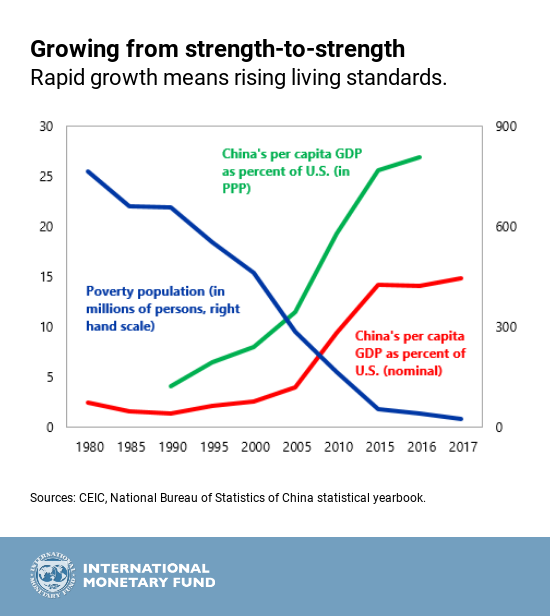
Secondly, Alston claims that the benefits of economic growth are mostly captured by the rich and only worsens inequality and the plight of the poorest members of the world.
Between 1980 and 2016, the top 1 percent captured 27 percent of total real income growth, and in 2017 captured 82 percent of new wealth. Meanwhile, incomes of the poorest have grown far slower than global GDP.
However, what we have seen is incomes between developed and underdeveloped nations beginning to converge alongside large reductions in poverty.
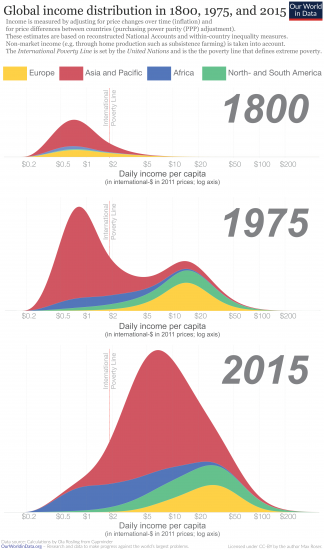
Over the following 4 decades the world income distribution has again changed dramatically. There has been a convergence in incomes: in many poorer countries, especially in South-East Asia, incomes have grown faster than they have in rich countries. Whilst enormous income differences remain, the world no longer neatly divides into the two groups of ‘developed’ and ‘developing’ countries. We have moved from a two-hump to a one-hump world. And at the same time, the distribution has also shifted to the right—the incomes of many of the world’s poorest citizens have increased and extreme poverty has fallen faster than ever before in human history.
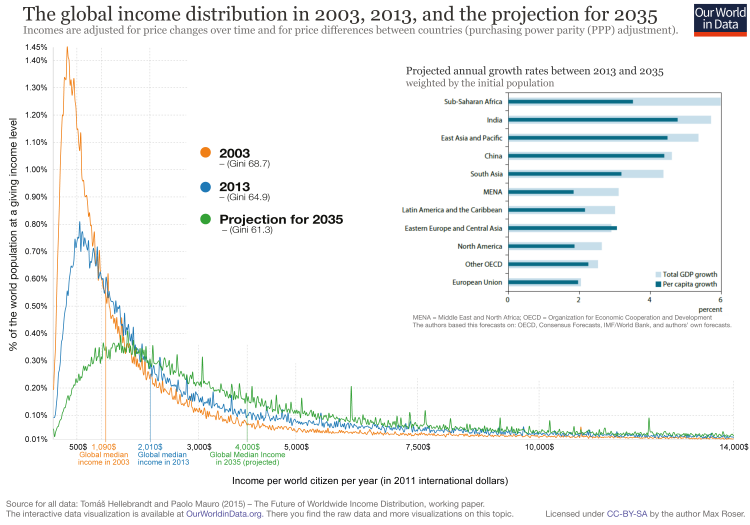
Contrary to Alston, there is no dichotomy between economic growth and inequality. The recent growth in low-income countries is actually beginning to reverse inequality. and projections expect inequality to continue to decline as income rises.
With rapid growth in much of Asia in particular, the global distribution of incomes became less unequal. The incomes of the poorer half of the world population rose faster than the incomes of the richer half of the world population.
Part of Alston paper deals with the economic impact of the ongoing COVID pandemic. This will surely reverse the progress we’ve made so far. World leaders and economists need to start talking strategies that will help us best recover from the pandemic.
Book Review: ‘The Structure of Production’
Economics, as it has been taught for at least the past 50 years, has been dominated by the “Neoclassical Synthesis.” This paradigm is in large part thanks to the Keynesian Revolution fostered by Keynes’ followers such as John Hicks, Paul Samuelson, and many others. And while the work of Milton Friedman and the Chicago School may have been an addition to the contemporary orthodoxy, the “Monetarist Counterrevolution” was more of a reformation of the current paradigm than a revolutionary shift.
Friedman famously said “we’re all Keynesians now,” but what did he mean by this? In his own words:
We all use the Keynesian language and apparatus; none of us any longer accepts the initial Keynesian conclusions
Much of contemporary economics still operates under the framework laid out in Keynes’ General Theory. The advancements in the science have been a continuation, not a rejection of Keynes’ work. GDP and the AS/AD model have been Keynes’ most lasting contributions and no macroeconomist today works without reference to them. It is this that Mark Skousen seeks to change in his book The Structure of Production.
A Production Orientated Framework
Skousen argues that the use of GDP and aggregate supply and demand models in the mainstream have led to a deficient view of the economy. The contemporary framework gives a subtle implication that the economy is demand-driven. This can be seen in the formulation of GDP (C + I + G + NX). GDP measures our economy as the aggregate output on final consumer goods, leading one to believe that is final consumption that determines the level of output. The AS/AD model too also only depicts the economy in terms of the supply and demand of final goods.
For Skousen, this completely ignores the backend of the economy. Measuring the economy ought to be holistic and consider output at various stages of production.
Spending at the final stage of production (GDP) is important, but so is spending at each of the intermediate stages… There are literally millions of intermediate transactions occuring prior to the sale of finished goods and services to final users.
(xxviii)
In place of GDP, Skousen argues to use Gross Output (GO) as a better measurement of the economy. GO accounts for the value of output at all stages of production. Skousen found that GO was twice the size of GDP and that business investment was the largest component. He, therefore, concludes that greater attention ought to be placed on business decisions and trends throughout the production process, rather than neglect it in favor of analyzing final consumption as most economists do today.
The Austrian Influence
Mark Skousen follows the tradition of the Austrian school of thought and he draws upon the ideas developed by the school to put forth his arguments. For Skousen, it is contemporary capital theory that he finds most problematic. Modern economics capital theory is significantly influenced by the works of John Bates Clark and Frank Knight. Their theories assume that capital lasts forever, that there are no intermediate goods, no time factor, workers don’t save, and capitalists do not consume.
It is these assumptions that can cause one to neglect the importance of stages of production. Capital in this sense is seen as static and uninteresting even. Skousen and the Austrian school are diametrically opposed to this. For them, capital theory is central to explaining economic fluctuations.
The Austrians, in contrast to Clark and Knight, emphasize the time aspect and heterogeneity of capital. The 19th-century economist Eugene Bohm-Bawerk argued that capital was used to create a more “roundabout” production process. That is, capital creates more time-consuming processes.
An elementary explanation of roundaboutness can be explained as follows. Imagine Crusoe attempting to fish on his deserted island. He could directly attempt to fish with his bare hands (although it’s not very effective). Or alternatively, he may develop a capital good (e.g., a fishing net) first and then go out to fish. This latter decision creates a new stage of production, that is producing a fishing net, which requires time to create before it can be used for final consumption.
Secondly, capital is heterogeneous and aggregate conceptions of capital grossly underestimate the importance of this. Capital goods are designed for specific tasks, the more specific they are, the less fungible they are. This is the reason why they create a vital role in economic fluctuations, capital can’t be easily liquidated or moved around during economic downturns and so they end up causing huge losses to firms.
A New Approach to Business Cycles
The last half of the book uses Austrian capital theory to present a new model of the Macroeconomy. Against the AS/AD model which models the economy in terms of final output, Skousen develops the Aggregate Production Structure model which illustrates output at every stage of the production process. In this new model, time is fundamental to explaining the economy.
In the APS, the structure of supply and demand across the economy is determined by the time preferences of economic actors. Here, an increase in time-preference causes people to save more giving businesses funds to invest in capital goods, leading to a lengthening of the APS and economic growth.
Skousen uses the APS model to explain economic fluctuations. He gives a theoretical explanation and statistical evidence of why prices are more volatile as you go up the stages of production.
From this, he explains how under the current fiat banking system, an increase in the money supply causes a boom in the capital goods sector. Businesses undergo investments that now seem profitable that weren’t before. But because this expansion was not funded by an increase in voluntary savings, the unchanged consumer time-preference will eventually start putting upward pressure on interest rates and the cost of real resources. These investments become unprofitable and a credit crunch. Businesses abandon these investments, thereby furloughing workers and reducing output.
Skousen ends the book by examining several different policy decisions. He criticizes Monetarist and Keynesian approaches for ignoring how inflation has varying effects on prices through the production process.
He contemplates a monetary policy that puts money directly in the hands of consumers, rather than businesses in intermediate stages of production. This would make sure expansion only happens at the end of the production process and avoid widespread distortions. However, this approach would mean the government making direct transfer payments to citizens or spending it directly themselves which could lead to a dangerously inflationary regime without an institutional restraint.
He also considers a gold standard that many Austrians endorse. Skousen himself believes that a gold standard regime would be the most stable money system. However, it’s implementation would be politically unfeasible as such a change would cause a severe recession and a massive transfer of wealth.
Overall Skousen’s book points out a lot of issues in the field today that economists ought to confront. We must adopt a more holistic view of the economy if we are to better understand it. It can also help elucidate phenomena during a business cycle that most economists ignore, principally the reason why capital goods experience more volatile fluctuations than consumer goods.
Oil Goes Negative
Oil Futures are selling below zero. The excess supply of oil production comes from the ongoing dispute between Saudia Arabia and Russia. As a result, the dollar is appreciating in the foreign exchange markets and the 5-year forward inflation expectations dropping to .5% today. More signs that this coronavirus recession is going to be a huge deflationary shock.
The Unusual Demand Shock
Michael Hoffman points out that we’re not seeing a typical negative demand shock, there’s also been a significant disruption on the supply side
What began as a reduced supply of imports to the US from China has developed into an even deeper supply-side issue, with government-enforced shutdowns for “nonessential” businesses, rising domestic unemployment, and reduced production as a record 6.6 million Americans filed for unemployment benefits in the last week of March.
Now following up on this, Hoffman personally believes the result of this coronavirus shock is indeterminate. There are too many variables at play, some inflationary and some deflationary. However, I think any inflationary forces will be outweighed in magnitude by the deflationary forces. The American economy is projected to face disinflation/deflation accompanied by high unemployment, much like a typical demand shock.
However, this is not a typical demand shock. Global supply-chains have seen an unprecedented disruption. A reduction in output would lead to shortages and rising prices as one would expect. However, in the case of this pandemic, we have seen something paradoxical: the supply shock has turned into a secondary demand shock.
Hoffman believes aggregate demand hasn’t fallen, in fact, he argues any decrease in demand will be in the short run but even then we have seen shortages of essential goods like food and toilet paper due to an influx of demand for these items.
However, Hoffman’s analysis is misguided since he’s looking at things through the AS/AD framework. For one, shortages for essential goods should be seen as a short-run increase in demand; consumers are stocking up in preparation for long term isolation. Secondly, just because there are shortages for these goods does not mean there is an overall increase in aggregate demand. While grocery stores may be experiencing higher demand, this is only one sector of the economy. If we look at things holistically, we’ll see there’s been a greater decrease for consumer goods and services as restaurants, retail stores, airlines, car dealerships, etc., close down due to sharp decreases in customers.
Secondly, the AS/AD framework fails to adequately capture the disruption in supply chains. Aggregate demand only accounts for the final demand for goods and services and ignores business to business (B2B) transactions. Reports on gross output have shown that B2B spending in the supply chain has declined by 1.7% in the last quarter as firms anticipated an economic downturn from the virus’ impact on China. Such drops in B2B spending are very significant given that they are twice the size of consumer spending and they will undoubtedly exert strong deflationary pressure on the economy.
The immediate effects of negative supply shock may see some temporary price increases but the decline in business to business activity will have firms go under and workers laid off. Further increases in unemployment will lead to a decline in income and therefore a reduction in consumer spending (and demand).
Financial markets seem to agree. The dollar has appreciated in the foreign exchange market and inflation expectations have seen a steep decline.

But could the government’s fiscal and monetary stimulus, lead to an unexpected rise in inflation? Probably not:
“The lesson from 2008 is that we had a fair amount of fiscal stimulus and monetary stimulus and people thought we were getting hyperinflation, and that clearly didn’t happen,” said Eric Stein, co-director of global income at asset manager Eaton Vance. He added that fears over deflation, too, turned out to be “misguided”, and he sees inflation returning to just below the Fed’s target when the coronavirus outbreak passes
A rise in inflation will depend on the recovery from the pandemic. With the reduction of competitive markets as firms exit, there may be general price increases. And if Russia and Saudi Arabia are able to solve their dispute, oil prices will recover accelerating inflation further. But we are a long way from recovery, for the time being, we should expect greater deflationary pressures on the US economy.

